

Replacing Risky Trees for Wildfire Safety


Replacing Risky Trees for Wildfire Safety

The towering Coulter pine that once shaded Sue Keiger’s home from summer heat has become something else entirely: a risk.
“I love that tree,” she said. “It kills me to take it down. I wish I could keep it, but I also understand what’s at stake.”
A homeowner and an SCE vegetation management expert share the safety-driven decision behind removing a risky tree to lower wildfire risk.
Over the years, crews contracted by Southern California Edison regularly trimmed the pine’s branches to steer clear of nearby power lines. But as wildfire risk intensified across California, those trims became more frequent and extensive. For certain species — especially fast-growing or brittle ones like Coulter pines — trimming alone doesn’t always solve the problem.
“When trees are too large or don’t respond well to pruning, removal is sometimes the safest option,” said Chuck Dykes, an SCE project manager for Vegetation Management Strategy & Technology. “Our goal is to reduce risk, whether that’s contact with power lines, potential for falling limbs or the chance of ignition.”
Keiger has lived in her Cherry Valley home since 2001, long enough to notice how conditions around her have changed. What once felt manageable began to look different as winds picked up and fire seasons grew longer.
“On the side closest to the power lines, the tree needed to be completely cut back to the trunk, and on the other there was still this huge canopy and it started to lean,” she said. “With the winds we’ve been getting, the risk has just become too great.”
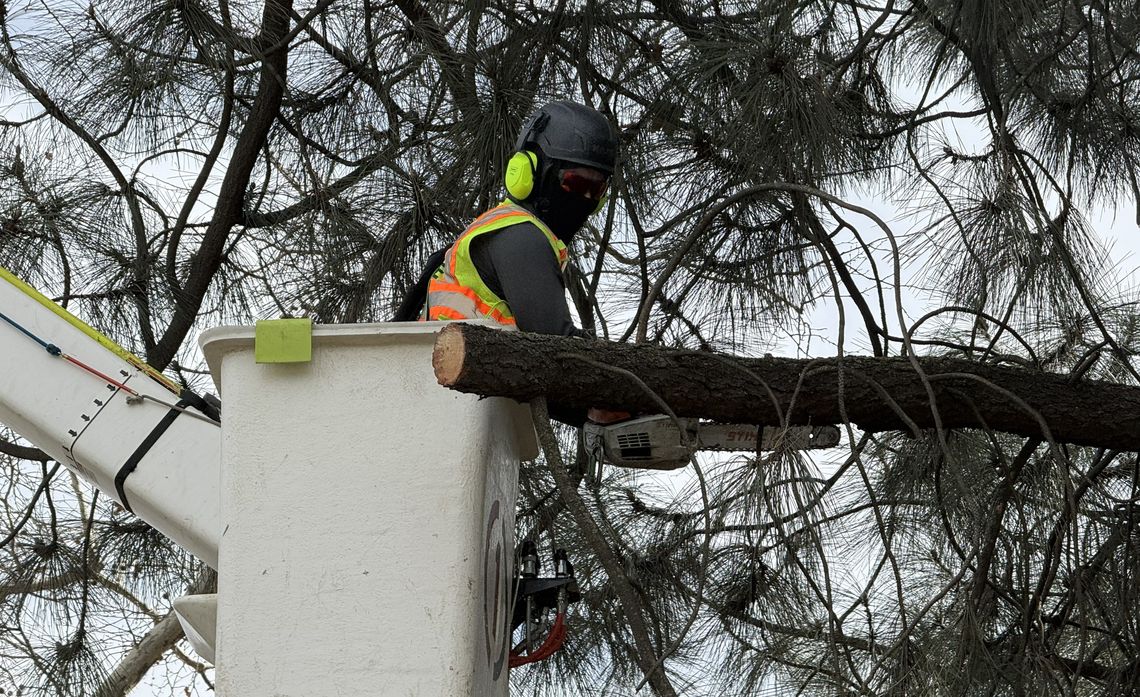
A mature Coulter pine comes down as part of SCE’s efforts to reduce wildfire and safety risk near electrical equipment.
That concern for public safety carries extra weight for Keiger, who spent 32 years as a deputy sheriff in San Bernardino County.
“You have a responsibility to your community,” she said. “If a tree like that comes down and takes out power lines, there’s a risk of fire. There’s a risk of someone getting hurt. I just can’t ignore that.”
SCE’s vegetation management program is designed to prevent those kinds of scenarios before they happen. Crews routinely inspect trees near power lines, trimming or removing vegetation when necessary to reduce fire and safety risk.
“We don’t take removals lightly,” Dykes said. “We know people are attached to their trees. But when a tree creates an ongoing safety hazard, we have to put public safety first.”
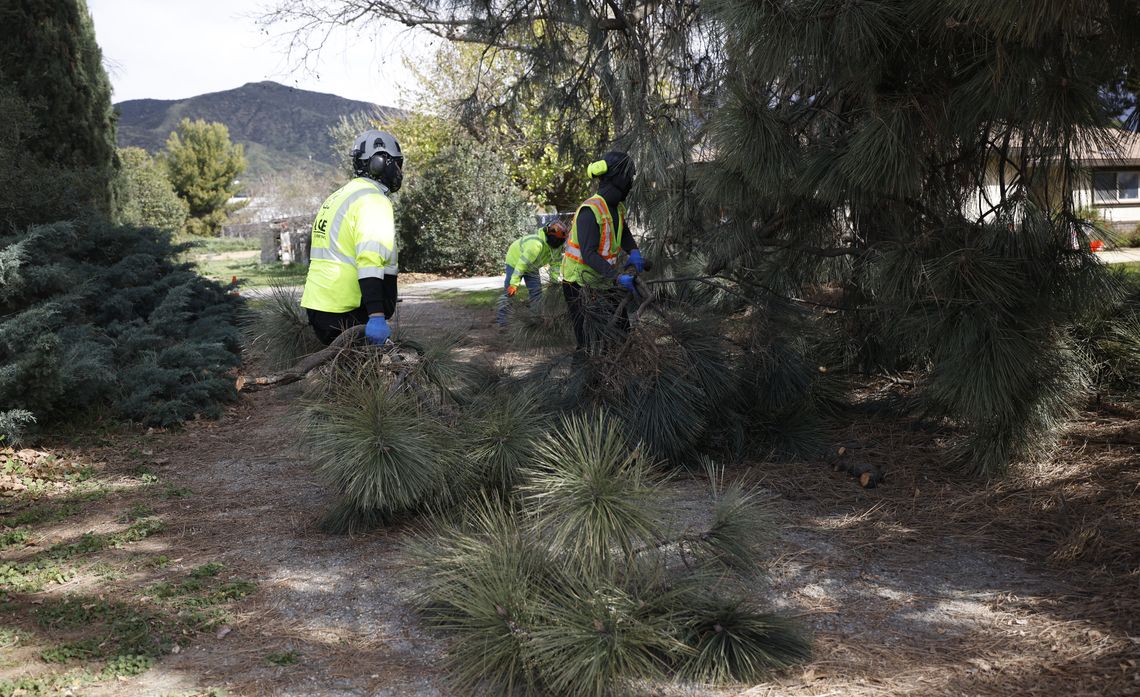
Strategic tree removals help keep power lines clear and communities safer during extreme weather.
When removals are needed, SCE also offers tree replacement options to help customers replant safely. Through a new partnership with the Arbor Day Foundation, customers can use an interactive online portal to explore approved tree species suited for the area, visualize how a tree fits in their yard near power lines, and get expert guidance on where and how to plant.
The idea, Dykes said, is simple: “Right tree, right place — so the next tree doesn’t become the next problem.”
The decision to remove the tree and eventually replant reflects a balance between what Keiger loves and what she knows is necessary.
“It’s hard,” she said. “But things are different now. The climate is changing. The fires are real. I’m letting something go to make way for a fresh start, and a safer one.”
For more information on SCE’s wildfire mitigation efforts, visit sce.com/wildfiresafety.
Communications around electrical safety are funded by ratepayers.