When a fire starts, seconds matter. That is why Southern California Edison continues to invest in year-round wildfire safety and resilience tools — including the Quick Reaction Force (QRF).
“The QRF reflects a shared commitment to wildfire safety and community protection,” said Tom Brady, SCE principal manager of Business Resiliency. “It provides added aerial firefighting capabilities to support local fire agencies during critical wildfire weather conditions, and helps protect SCE’s equipment.”
Since 2021, SCE has funded the helitanker partnership which gives Los Angeles County, Ventura County and — until this year — Orange County access to aerial firefighting tools, including three Boeing CH-47 Chinook helicopters and a S-76 intelligence aircraft.
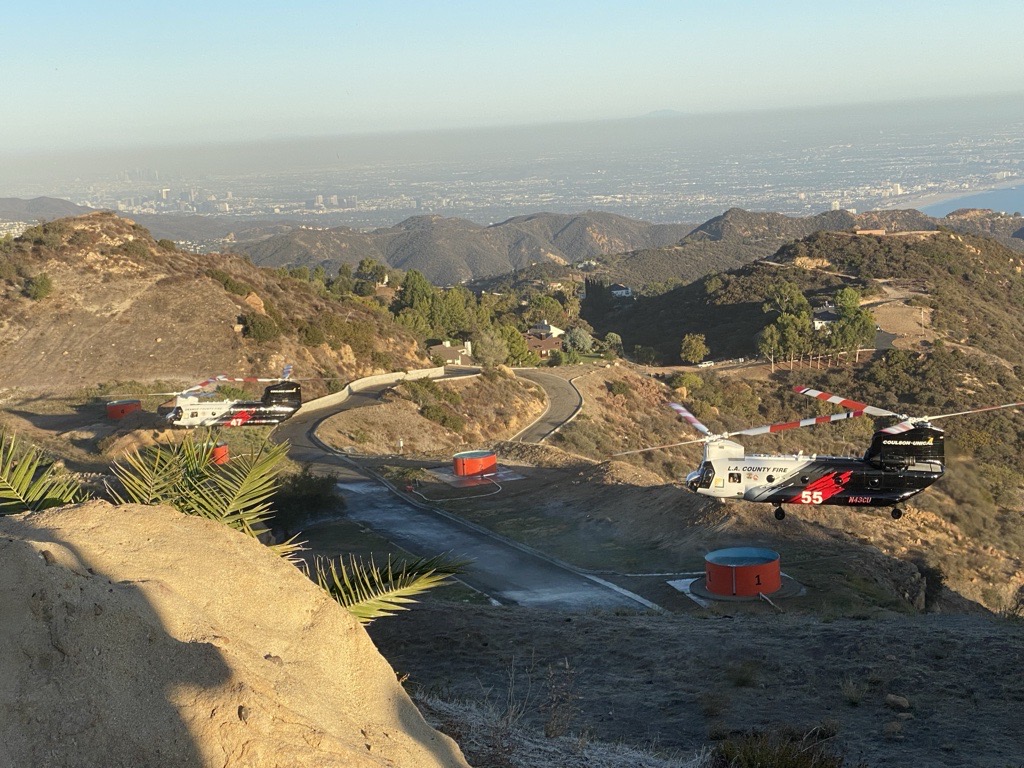
“The QRF is a critical tool for early fire suppression,” said Troy Whitman, one of SCE’s senior advisors in Fire Management. “The helicopters can hover to refill their tanks at night without landing — a first‑of‑its‑kind capability — allowing for rapid refills of up to 3,000 gallons of water or retardant. Their ability to respond quickly is key to keeping small fires from turning into big ones.”
Over the last five years, the QRF has been deployed to 256 fires and dropped 11 million gallons of water.
During the 2025 fires and windstorms, the helitankers made up 70%-80% of all drops across local, state and federal agencies — that’s over 1.3 million gallons of water and fire retardant over eight days and nights.
Recent QRF statistics:
-
2023: Deployed 464 times and dropped over 935,000 gallons of water and fire retardant.
-
2024: Deployed 258 times to 88 unique fires across seven counties.
-
2025: Deployed 94 times to 43 unique fires, dropped 2.37 million gallons of water and fire retardant, and logged 267 flight hours.
When a fire breaks out in Southern California, local fire agencies coordinate to quickly dispatch the QRF. The program is intended to strengthen rapid response, which can help limit damage and reduce overall firefighting costs.
Currently, the resources are largely funded by SCE customers as part of a broader effort to improve wildfire response and community safety. But wildfire risk is a shared challenge, and no single organization can address it alone.
“Balancing affordability for our customers and public safety is a key priority for us,” said Brady. “We’re happy to be continuing our partnership with the intent that it will transition to the appropriate funding. SCE is working with fire agencies and elected officials to pursue a shared funding model.”
Starting in 2026, the Los Angeles County Fire Department and Ventura County Fire Department have both committed to taking on a piece of that funding.
“This was about making a smart, long-term investment in wildfire readiness,” said Ventura County Fire Chief Dustin Gardner. “The Quick Reaction Force has proven its value, and by sharing funding with Southern California Edison, we’re ensuring the program remains strong and sustainable.”
For more information on SCE’s wildfire safety efforts, visit sce.com/wildfiresafety.
Communications for this program are funded by ratepayers.