


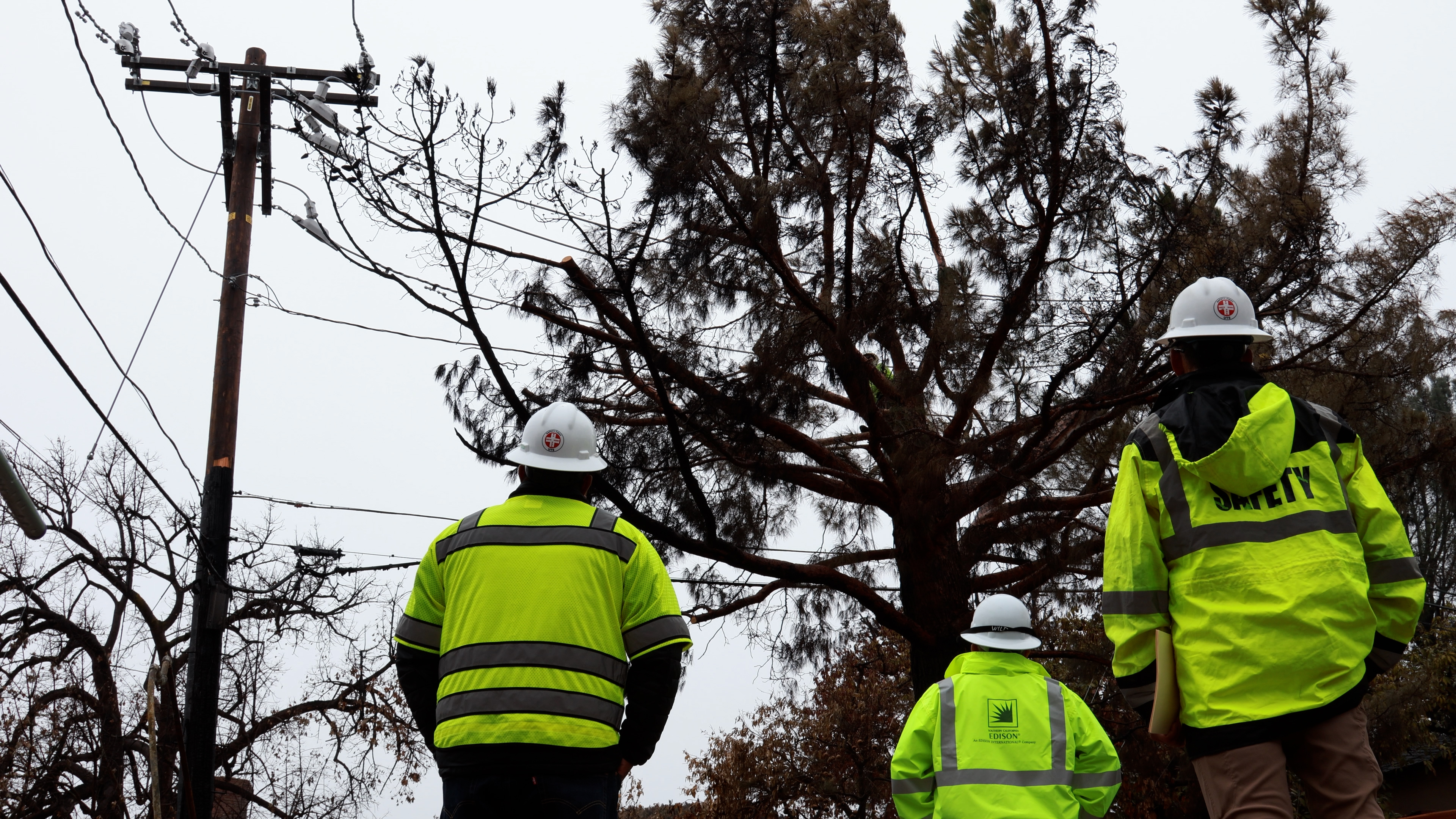
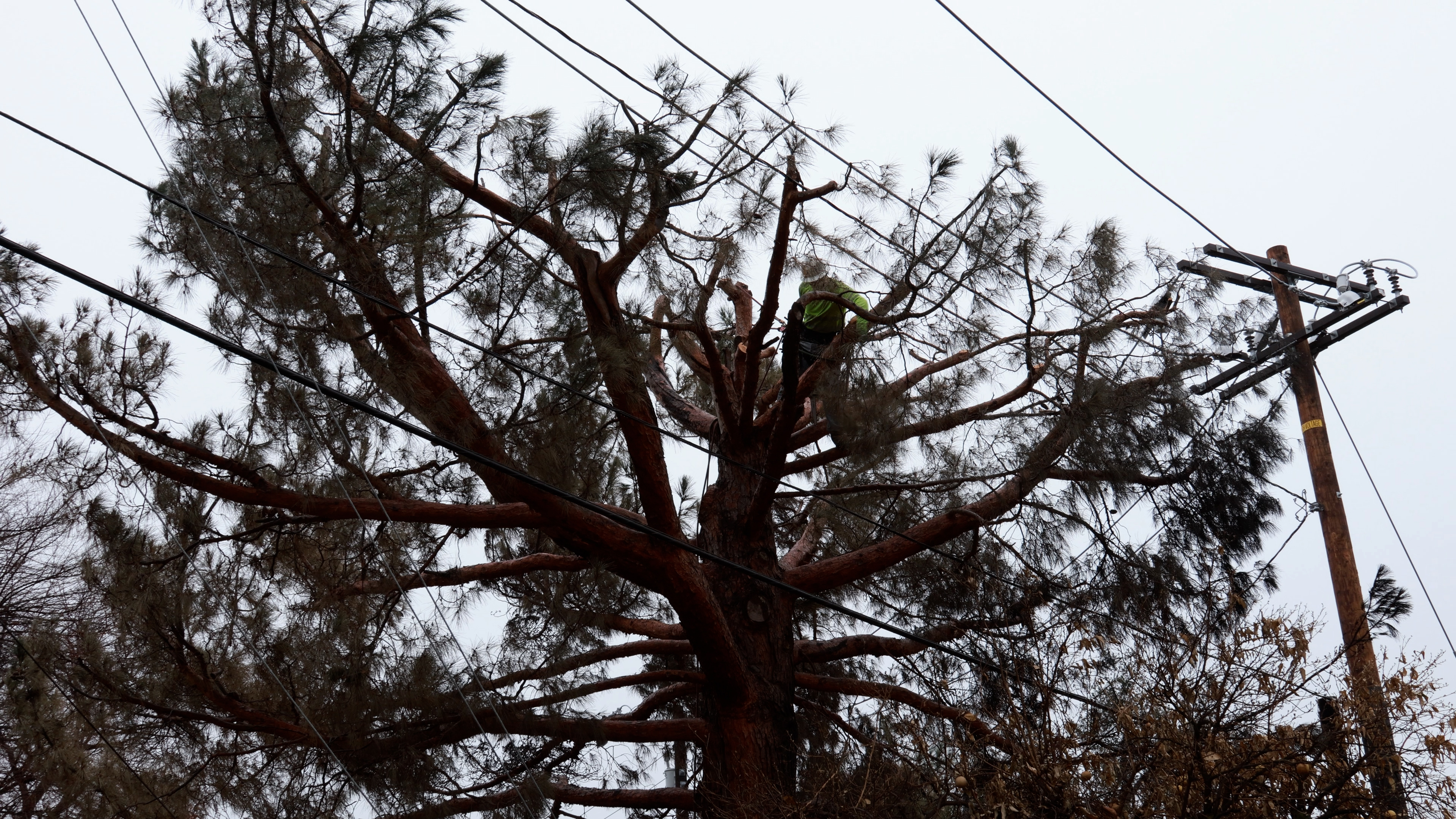
In an Altadena front yard, where the home is gone but a giant cedar deodar remained following the Eaton Fire flames, vegetation crews worked on a full removal of the 65-foot tree.
Though the mighty cedar was still standing tall, the burnt bark and missing green foliage were signs of damage to its structural integrity.
“It can be hard to tell, but if the flames penetrate into its vascular system, survival is low,” said Southern California Edison Vegetation Management and Forestry Manager David Guzman. “Often, it’s just a matter of time before the tree gives out.”
SCE Vegetation Management crews help maintain safety by removing hazardous trees after the Eaton Fire.
Without intervention, the tree limbs have a high likelihood of failing during the next wind storm and falling into nearby power lines.
Protecting SCE equipment from the impacts of frail or overgrown trees is part of Vegetation Management’s core work. They assess over 1.6 million trees annually through their routine line-clearing program.
Down the street, a second crew worked in a resident’s backyard to trim branches that were dangling near newly restored power lines, now upgraded with coated wire, called covered conductor.
At the height of the restoration effort, Guzman’s team of SCE utility arborists was overseeing nearly 17 tree risk assessors and 82 vegetation crews throughout the Altadena area.
Their main focus — remove tree hazards that could interfere with lineworkers so they could safely rebuild fire-damaged equipment as quickly as possible while also ensuring the newly rebuilt electrical lines are not vulnerable to future tree failures.
“Whenever there is a weather event where a lot of restoration is required, we try to get out ahead of the line crews,” Guzman said. “We send a damage assessment team looking for trees that have been compromised during the storm.”
After the Eaton Fire, Guzman’s team identified and dealt with over 3,500 trees in the burn scar that posed a threat to SCE crews and equipment.
“There were so many burnt trees, some even still burning and near our lines,” he said.
Others sustained damage but did not pose an immediate threat, allowing time for the trees to try and recover before intervention is needed. These are known as “subject trees” which continue to be monitored for signs of deterioration.
“It’s a balance,” Guzman said. “Our job is focused on safety, but as arborists we do everything we can to preserve the trees that have survived these types of events.”
While much of their fire-related work is done, the vegetation team is constantly working to inspect and address the many trees in SCE’s service area which makes sure trees and shrubs do not grow into electrical wire.
“We work in this community on a regular basis. Seeing everything that they have gone through is devastating,” Guzman said. “Residents’ safety is our top priority. We want to do everything we can to make their rebuild process easier.”
For more information on SCE’s vegetation management efforts, visit sce.com/powerlines.



 is briefed on the safety protocols in place at the tree removal site. =http://energized.staging1.iprdev.com/_gallery/get_file/?file_id=67d1fb163d633237ab4b82d4&file_ext=.jpg&page_id=67d211083d6332c1134b82b7)